








Can Diesel Additives Reduce DPF Regens? A Chemist Explains
By Jessica Crabtree
Director of Technical Services,
Power Service Products
August 14, 2026
How Do Diesel Additives Reduce DPF Regens?
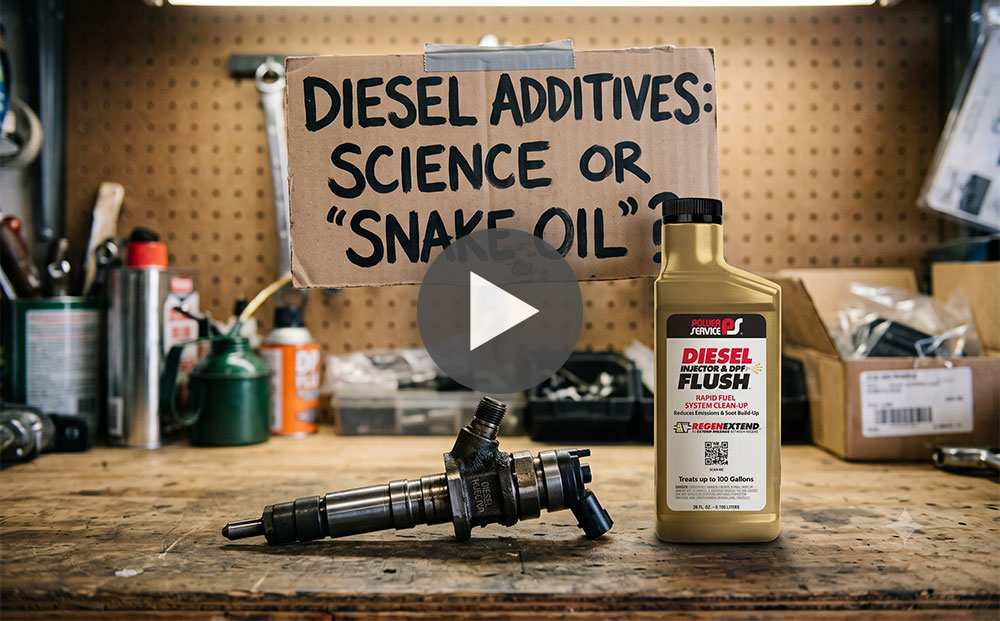
Have you ever wondered what actually happens inside your fuel system and emissions equipment when you use a quality diesel additive? Is it backed by real chemistry or is it just “snake oil”?
On a recent episode of the Pickup Truck + SUV Talk Podcast, host Tim Esterdahl sat down with Power Service Director of Technical Services, Jessica Crabtree. In the episode — “Can Diesel Additives Reduce Regens and Clean Your DPF? A Chemist Explains” — she details how specialized additive chemistry restores injector spray patterns, saves money at the pump, and prevents costly DPF downtime.
Key Takeaways from the Podcast
1. Fuel Economy Improvements & Cost Savings
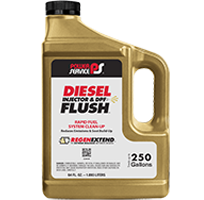
• Advanced detergent technology in high-dose formulas like Diesel Injector & DPF Flush rapidly cleans internal diesel injector deposits (IDIDs), restoring precise fuel atomization and optimal spray patterns.
• Average Savings: Restoring optimal combustion efficiency allows engines to extract maximum energy from every drop of fuel, delivering driver savings averaging 6 to 8 cents per gallon.
• Fleet Testing: In a controlled study tracking eight 3.0L Duramax diesel trucks, fuel economy improved by approximately 15% following additive treatment.
2. Extended DPF Regeneration Intervals & DEF Reduction
• Active DPF regenerations waste extra fuel to burn off trapped soot inside the particulate filter. Powered by REGENEXTEND® technology, Diesel Injector & DPF Flush targets soot buildup at the source:
• Lower Soot Production: Restoring precise fuel atomization ensures a more complete burn, drastically reducing the unburned soot and hydrocarbons entering the exhaust system.
• Extended Driving Intervals: With fewer soot particles reaching the particulate filter, driving intervals between required active DPF regenerations are extended, reducing costly downtime.
• Optimized DEF Usage: Cleaner exhaust stream conditions reduce the workload on catalytic and downstream emissions systems, helping optimize DEF fluid consumption over time.
3. Rapid Injector & System-Wide Cleaning
• For engines suffering from severe deposit buildup or lost power, high-dose formulas like Diesel Injector & DPF Flush go to work almost immediately after hitting the tank.
• 30-Minute Restorative Power: Fast-acting detergents start dissolving internal diesel injector deposits (IDIDs) and can restore optimal spray patterns within 30 minutes of normal highway driving.
• Downstream Component Cleanup: Cleaning benefits extend past the fuel injectors to help mitigate carbon buildup on EGR valves, turbochargers, and common rail equipment.
• Maximum Impact on High-Mileage Engines: Vehicles with heavy deposit buildup or engines that have never run a deep-clean treatment experience the most immediate recovery in throttle response, engine smoothness, and overall power.
Cost vs. Reliability: Preventing Clogged Injectors and DPF Failure
Replacing modern high-pressure common rail (HPCR) fuel injectors or emissions components like the DPF can easily cost thousands of dollars in parts and labor. Beyond direct shop bills, vehicle downtime directly translates to lost work, missed deadlines, and lost income.
Utilizing targeted, heavy-duty treatments like Diesel Injector & DPF Flush functions as crucial preventative maintenance. By quickly breaking down stubborn soot, clearing fouled injectors, and keeping particulate filters free-flowing, you protect high-dollar engine components and avoid premature failures.
Frequently Asked Questions (FAQ)
How fast do diesel fuel additives work to clean dirty injectors?
High-dose detergent formulas like Diesel Injector & DPF Flush start dissolving tough internal diesel injector deposits (IDIDs) and can restore optimal fuel atomization within 30 minutes of normal highway driving.
Will fuel additives void my vehicle manufacturer warranty?
No. Power Service formulas are subjected to rigorous industry-standard “no-harm” testing, ensuring they are 100% safe and fully compatible with OEM high-pressure common rail (HPCR) systems, catalytic converters, and DPF equipment.
Do fuel additives reduce Diesel Exhaust Fluid (DEF) consumption?
Yes. By promoting complete combustion, Diesel Injector & DPF Flush reduces soot and unburned hydrocarbons before they reach the exhaust stream. This lightens the workload on downstream catalytic systems, helping optimize DEF usage over time.
Watch or Listen to the Full Podcast Episode
Learn more about diesel fuel chemistry and watch the full interview on the Pickup Truck + SUV Talk Podcast YouTube channel or wherever you listen to podcasts.
Listen to the Full Episode Here
ABOUT THE AUTHOR
Jessica Crabtree, BS Chemistry (ACS Certified)
Jessica is the Director of Technical Services at Power Service Products, bringing over 12 years of specialized experience in fuel system performance and maintenance. Analyzing over 2,000 fuel samples annually, she provides data-driven insights into real-world fuel quality, fuel stability, and equipment longevity. An active member of ASTM Committee D02, she leverages her technical expertise to help fleets and drivers optimize fuel efficiency and ensure operational reliability in all seasonal conditions.