







Why Record Diesel Prices Demand a New Maintenance Playbook
By Jessica Crabtree
Director of Technical Services,
Power Service Products
October 1, 2026
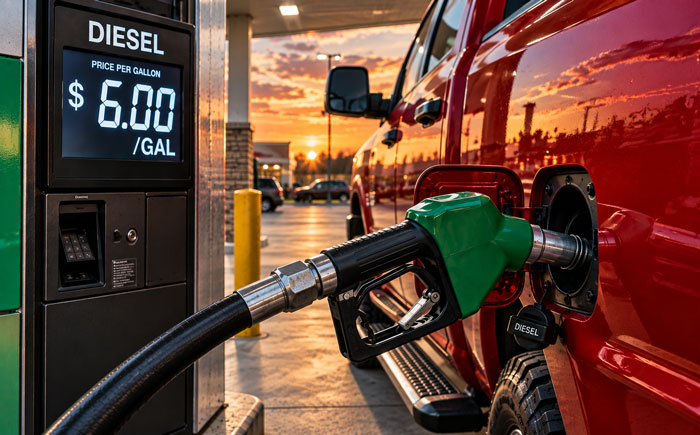
When diesel hovers at record highs, fuel economy stops being an abstract metric on a dashboard and becomes an immediate drain on your operating budget.
At today’s prices, running degraded fuel hardware costs real money every mile. Yet, as fuel prices climb, the industry gets flooded with generic mileage claims promising double-digit gains overnight.
Physics doesn’t work that way. But what you can do—and what modern High Pressure Common Rail (HPCR) engines require—is stop burning extra fuel to overcome dirty hardware.
The Hidden Fuel Drain: HPCR Tolerances and Distorted Spray Patterns
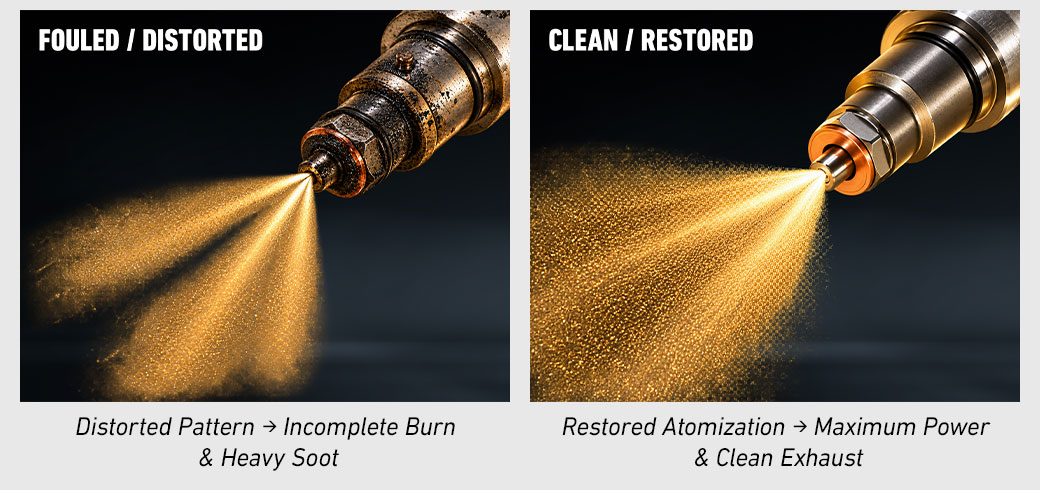
Modern HPCR injection systems operate at extreme pressures exceeding 30,000 psi, with internal injector clearances measured in single-digit microns. Under these punishing temperatures and pressures, fuel undergoes thermal breakdown, forming stubborn Internal Diesel Injector Deposits (IDIDs) alongside external nozzle coking.
When deposits form on internal needles and microscopic nozzle orifices:
1. Fuel Atomization Degrades: Instead of a fine, uniform vapor mist, the injector produces larger, uneven fuel droplets.
2. Combustion Is Compromised: Larger fuel droplets do not vaporize quickly enough during the brief combustion window, leading to incomplete burn and lost power per stroke.
3. Drivers Overcompensate: As usable torque drops, drivers naturally apply more throttle to maintain cruising speeds and load capacity, burning more gallons per hour.
The Double Penalty: How Incomplete Combustion Triggers Active Regens
The fuel lost during poor combustion is only the first expense. The unburned hydrocarbons don’t simply vanish; they exit the cylinder as heavy particulate matter (soot) that packs straight into the Diesel Particulate Filter (DPF).
Once differential pressure sensors detect an elevated soot load, the engine control module initiates an active regeneration cycle. During an active regen:
• The engine injects raw diesel downstream during the exhaust stroke.
• That fuel travels to the Diesel Oxidation Catalyst (DOC) to ignite and raise exhaust gas temperatures above 1,000°F (550°C).
• The intense heat incinerates accumulated soot into ash.
Every active regen consumes additional gallons of diesel strictly to clear the exhaust system. If your injectors are fouled, your engine generates excess soot, driving the truck into frequent, fuel-draining active regens. You pay for the wasted fuel in the combustion chamber, and then pay again for the fuel burned in the exhaust pipe.
The 2-Step Routine: Reset the Hardware, Maintain the Gain
Recovering lost baseline efficiency requires addressing both existing deposit buildup and continuous fuel degradation at the pump.
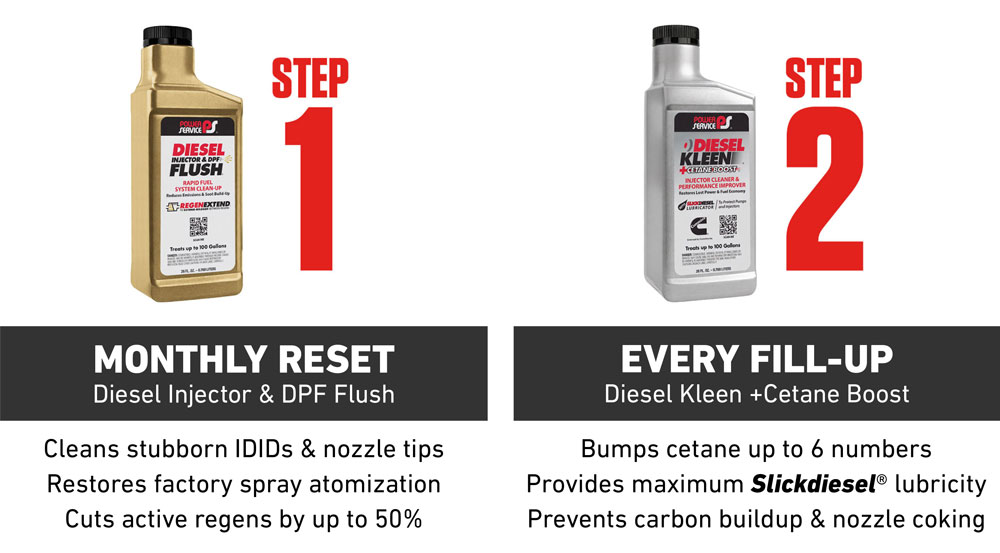
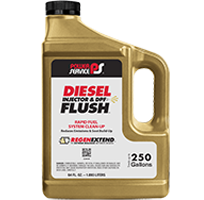
Step 1: The Monthly Reset (Diesel Injector & DPF Flush)
• Run through the fuel tank once per month. Formulated with targeted chemistries to remove tough carboxylate and polymeric IDIDs that standard detergents cannot touch:
• Restores Precision Atomization: Cleans internal moving needles and nozzle holes to restore correct spray geometry.
• Cuts Regen Frequency by up to 50%: Eliminating soot at the point of combustion stops excessive loading in the particulate filter before it triggers an active burn cycle.
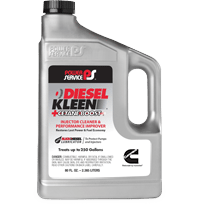
Step 2: Continuous Defense (Diesel Kleen +Cetane Boost)
Add to the fuel tank at every fill-up to protect common-rail components and optimize ignition:
• Boosts Cetane up to 6 Numbers: Shortens ignition delay, yielding a faster, smoother, and more complete burn cycle.
• Delivers Slickdiesel® Lubricator: Provides high-performance lubricity that exceeds ASTM D975 standards, shielding high-pressure pumps and injector needles from premature abrasive wear caused by Ultra-Low-Sulfur Diesel (ULSD).
• Keeps Nozzles Clean: Prevents new carbon deposits from taking hold, ensuring fuel economy does not slide backward between monthly flushes.
The Financial Return on a 6% Efficiency Recovery
In modern common-rail platforms, restoring degraded spray patterns and eliminating unnecessary active regens routinely recovers 5% to 8% in lost fuel efficiency.
Using a conservative 6% baseline recovery on a truck averaging 15.0 MPG:
| Operating Metric | Untreated Baseline | Treated (6% Recovery) | Net Benefit |
|---|---|---|---|
| Fuel Economy | 15.0 MPG | 15.9 MPG | +0.9 MPG |
| Fuel Cost per Gallon | $6.00 | $6.00 | — |
| Cost per Mile | $0.400 | $0.377 | -$0.023 / mile |
| Cost per 10,000 Miles | $4,000.00 | $3,770.00 | $230.00 Saved |
Treating fuel costs pennies on the gallon. When diesel prices hit record highs, recovering lost baseline efficiency and shielding high-pressure fuel injection equipment pays for itself immediately at the pump.
Technical Documentation & Testing Data
For detailed data and field testing, download our technical white papers:
A Case Study Measuring Fuel Economy in a Light Duty Diesel Vehicle Treated with PS DIDF
ABOUT THE AUTHOR
Jessica Crabtree, BS Chemistry (ACS Certified)
Jessica is the Director of Technical Services at Power Service Diesel Additives with 12 years of experience in fuel system performance and maintenance. By analyzing over 2,000 fuel samples annually, she provides unique, data-backed insights into real-world fuel quality and equipment longevity. An active member of ASTM Committee D02, she leverages her deep technical background to help fleet managers optimize fuel efficiency, reduce maintenance costs, and ensure reliability in varying regional fuel conditions.