








SEMA 2026 Technical White Paper & Field Data Release
Restore Combustion at the SourceSlash DEF Usage by Over 60%.
An extensive 20-tank commercial fleet study and controlled dynamometer sweeps confirm: removing injector deposits cuts Diesel Exhaust Fluid (DEF) demand by 60.2%, improves fuel economy by 11.5%, and recovers up to 8.5% peak torque and horsepower.
20-Tank Study
-60.20%
DEF Consumption
20-Tank Commercial Fleet Trial
Fleet Average
+11.53%
Fuel Economy
24.82 → 27.63 Fleet MPG
Dyno Verified
+8.5%
Peak Torque & HP
Immediate power recovery
Flow Schematic: High Pressure Common Rail Diesel
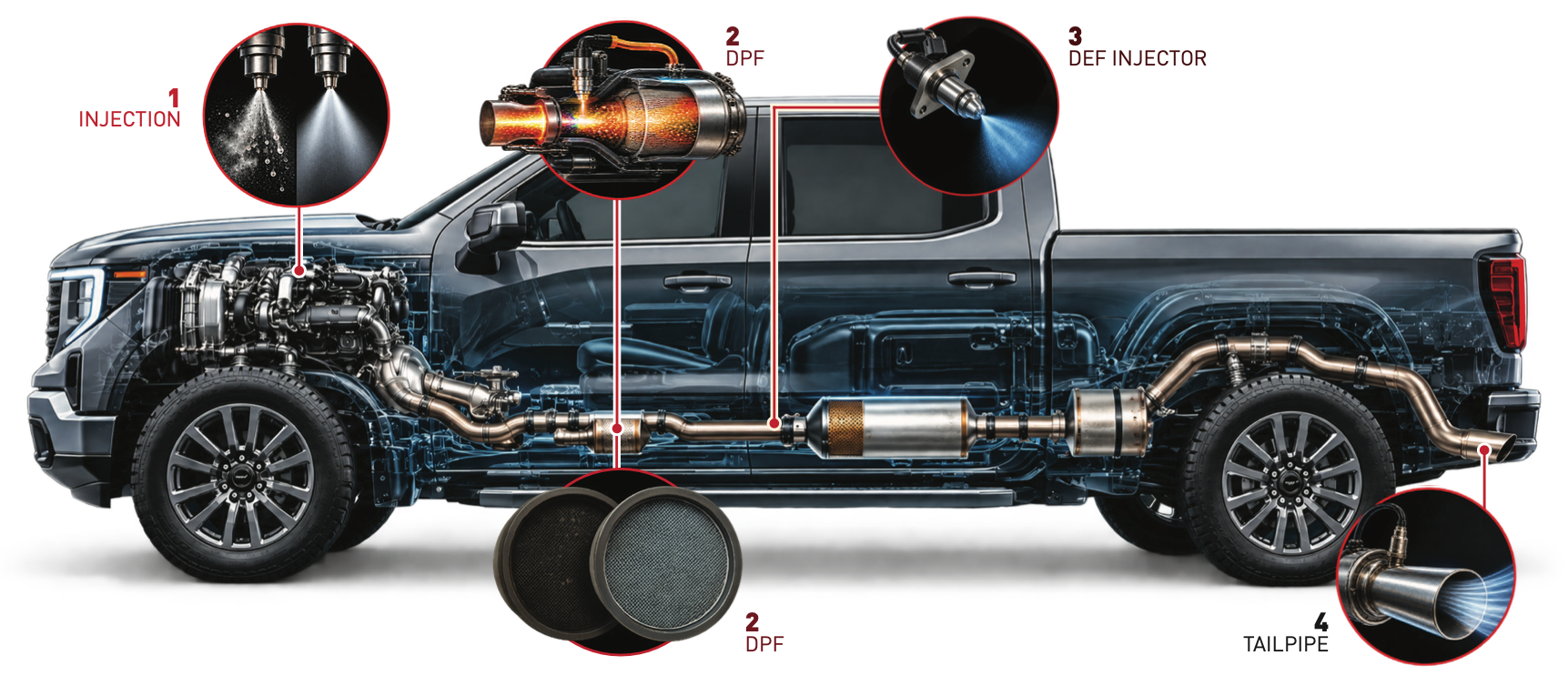
STAGE 01 • CYLINDER BURN
RESTORE ATOMIZATION
Fouled
Coarse Stream
Flushed
Fine Mist Cone
- +6.9% to 8.5% peak dyno torque/HP.
- Restores spray pattern in 1 tank.
- Fuel makes power instead of soot.
Converts more fuel into power and torque
STAGE 02 • FILTER CORE
DPF SOOT MIGRATION
clogged
High Backpressure
Restored
Open Honeycomb
- +65.7% extension between regens.
- Cuts active regen cycles up to 50%.
- Reduces post-injection
fuel penalty.
Fewer Regens = less wasted fuel
STAGE 03 • SCR CATALYST
SLASH DEF DOSING
-60.2%
DEF Dosing
Demand
- Diesel/DEF ratio drops 2.8% to 1.1%.
- Tank range > 4,000 miles per fill.
- Reduces wear on exhaust system.
Cuts DEF usage in half
STAGE 04 • EMISSIONS OUT
IN-CYLINDER CONTROL
-29.0% NOx
- Stops soot and raw HC at combustion.
- Prevents sensor de-rate codes.
- Zero visible smoke.
Restores factory emissions balance
THE BENCHMARK FLEET TRIAL & OPERATIONAL DATA
CONTROLLED 20-TANK SEQUENTIAL EVALUATION:
- Tanks 1–10 Untreated
- Tank 11 Diesel Injector & DPF Flush
- Tanks 12–20 Diesel Kleen + Cetane Boost
| Vehicle ID | Baseline DEF MPG |
Treated DEF MPG |
DEF Improvement |
Baseline Fuel MPG |
Treated Fuel MPG |
Fuel MPG Gain |
|---|---|---|---|---|---|---|
| Fleet Unit #1 | 609.42 | 1,104.17 | +81.18% | 21.67 | 24.35 | 24.35 (+12.33%) |
| Fleet Unit #2 | 691.87 | 1,083.40 | +56.59% | 24.67 | 28.71 | 28.71 (+16.35%) |
| Fleet Unit #3 | 651.08 | 1,169.00 | +79.55% | 25.65 | 29.01 | 29.01 (+13.13%) |
| Fleet Unit #4 | 1,162.54 | 1,435.26 | +23.46% | 27.26 | 28.43 | 28.43 (+4.29%) |
| Fleet Average | 778.73 | 1,197.96 | +60.20% | 24.81 | 27.63 | 27.63 (+11.53%) |
Operational Translation: What a 60% DEF Drop Means on the Road
Fleet operators rarely track DEF in isolated miles-per-gallon figures. Below is how the study numbers translate into operational driver uptime, refill frequency, and fuel-bay maintenance costs:
2.8% → 1.1%
DEF-to-Diesel Ratio
Cuts DEF usage as a percentage of fuel consumed by more than half, drastically reducing bulk warehouse fluid ordering volume.
4,000+ Miles
Per 5-Gallon DEF Tank
Extends highway fill range from ~2,000 miles to beyond 4,000 miles—keeping trucks on payload routes and out of service stops.
Studies 2 & 3: Dynamometer Cell Validation
Controlled Dynamometer & Certified Emissions Tests
Evaluating torque recovery and criteria exhaust emissions across high-hour agricultural machinery and consumer turbo-diesel pickups.
Case IH Magnum 220 Tractor
6.7L Turbo-Diesel • 4,400 Accumulated Field Hours
Tested on a calibrated eddy current PTO dynamometer in a climate-stabilized facility (70°F–75°F) with certified gaseous mass emissions monitoring over a continuous 70-hour operational cycle.
Max PTO Torque
+59 lb-ft
+6.9% Work Gain
Brake HP
+6.9% HP
175 → 187 HP
NOx Mass Reduction
-29.0%
7.8 → 5.5 mg/s
- 20-Hour Clean-Up Window: +59 lb-ft torque recovered rapidly as injectors cleared deposits.
- -29% NOx Reduction: Eliminating localized fuel hotspots in the cylinder stabilized peak combustion temperatures.
Dodge Ram 2500
6.7L Turbo-Diesel • Field-Aged Platform • High-Pressure Common-Rail
Loaded chassis dynamometer power sweeps conducted under stabilized operational temperatures to evaluate peak mechanical recovery in consumer and commercial pickup platforms.
Peak Torque
Up to +8.1%
Increase Peak HP
Up to +27 HP
Dyno Sweeps
Peak Wheel HP
Up to +8.5%
Immediate Dyno
- Immediate Throttle Response: Spray patterns restored to factory specifications without ECU tuning or hardware delete.
- No Teardown Required: Chemical detergent flush returns internal mechanical tolerances within a single tank.
The Two-Step Maintenance Protocol
How to Achieve and Sustain 60% DEF Reductions
The 20-tank trial proved that a single restorative reset combined with continuous maintenance delivers permanent operating benefits.
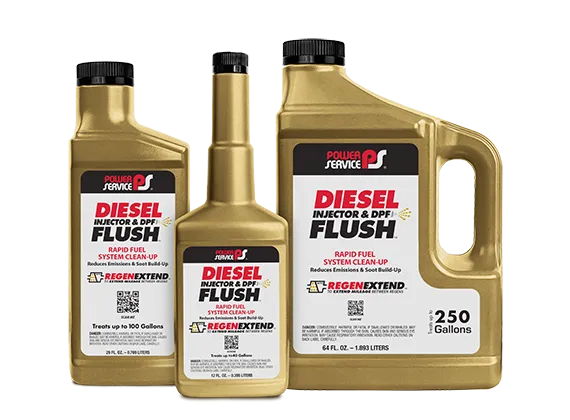
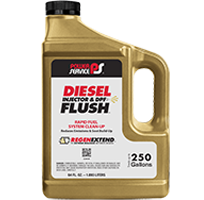
Diesel Injector & DPF Flush®
Powered by REGENEXTEND® Chemistry
Single-tank shock clean. Rapidly dissolves internal injector carboxylate deposits, restores precision spray pattern geometry, and flushes carbon through turbo, EGR, and DPF channels.
- Restores up to +8.5% lost torque and power in 20 hours
- Cuts DPF active regen frequency and duration by up to 50%
- Flushes entire fuel system in a single tank for rapid clean-up
- Removes stubborn injector deposits with a single tank use – including IDIDs and nozzle coking
- Improves fuel economy up to 10% (Light-duty Vehicles) (Heavy-duty Vehicles)
- Balances fuel injector flow rates for optimized combustion – smooths rough running engines
- Exclusive REGENEXTEND™ technology reduces the frequency and duration of regens up to 50%
- Cleans DPF and prevents premature clogging
- Reduces carbon and soot build-up on turbo, EGR and MAF sensor
- Reduces emissions, including NOx and black smoke, up to 50%
- Restores lost power and torque and improves acceleration
- Significantly reduces maintenance costs and downtime
Recommended Treatment: 1:500 ratio into fuel tank monthly.
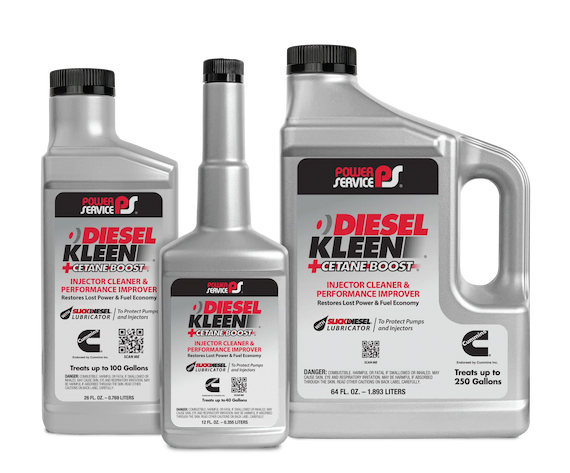
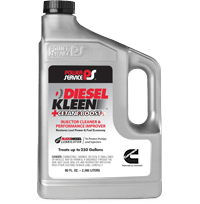
Diesel Kleen® + Cetane Boost
America’s #1 Diesel Performance Additive
Every-fill preventive chemistry. Prevents thermal deposit reformation, boosts cetane number up to 6 points for smooth ignition timing, and sustains maximum lubricity for HPCR fuel pumps.
- Locks in 60.20% DEF consumption reduction across all tanks
- Sustains 11.53% fleet fuel economy improvements continuously
- Endorsed by Cummins for use in diesel engines
- Cleans dirty injectors and prevents injector sticking in both High Pressure Common Rail (HPCR) and older systems
- Removes both internal and external deposits on fuel injectors
- Boosts cetane up to 6 numbers – engines run smoother with less power lag and faster cold starts
- Boosts power – reduces need for downshifting
- Restores lost power and fuel economy up to 7%
- Contains Slickdiesel Lubricator to protect fuel pumps and injectors from increased wear caused by poor quality Ultra Low Sulfur Diesel (ULSD) fuel
- Prevents formation and agglomeration of asphaltenes – prevents thermal breakdown
Recommended Treatment: Add at every fuel fill-up.
Media Kit & Fleet Engineering Center
Download Certified Research White Papers
Access raw fuel logs, dynamometer sweep logs, MRU exhaust gas recordings, and full research papers.
White Paper 01
20-Tank Commercial Fleet Field Trial
Complete individual log sheets for Units 1–4 across 20 tanks, tracking starting/ending mileage, fuel volume, DEF volume, and net MPG calculations.
White Paper 02
Case IH Tractor Dyno & Emissions Study
Calibrated PTO dynamometer sweeps and continuous NOx/CO2 mass exhaust measurements across 70 operating hours in a controlled testing cell.
White Paper 03
Dodge Ram 2500 Dyno Sweeps & Field Data
Dynamometer full-throttle loaded sweeps documenting peak wheel torque and horsepower recovery following the one-tank restorative flush.
Diesel Injector & DPF Flush
Additional Testing Data – Whitepapers
Preventing Common Diesel OBD-II Codes with Power Service Diesel Injector & DPF Flush
A Case Study Measuring Fuel Economy in a Heavy-Duty Diesel Vehicle Treated with Power Service Diesel Injector & DPF Flush
Diesel Injector & DPF Flush is Essential in Winter
Measuring NOx Reduction on Heavy Duty and Light Duty Diesel Engines Using Power Service Diesel Injector & DPF Flush
A Case Study Measuring Fuel Economy in a Light Duty Diesel Vehicle Treated with Power Service Diesel Injector & DPF Flush
Monitoring the Effectiveness of Diesel Injector & DPF Flush on Diesel Particulate Filter Regenerations
Evaluating Diesel Injector Cleaners Using the DW10B Test: A Look at Power Service Diesel Injector & DPF Flush
Diesel Particulate Filters (DPFs): How They Work, Why They Matter, and How to Keep Them Running Right
Frequently Asked Questions (FAQ)
Why is my modern diesel engine using so much Diesel Exhaust Fluid (DEF)?
Excessive DEF consumption is primarily driven by injector deposit formation rather than a malfunctioning aftertreatment system. High pressure common rail injectors operate at pressures exceeding 30,000 psi through microscopic spray holes. Over time, thermal breakdown creates internal diesel injector deposits (IDIDs) and external nozzle tip coking, which distorts spray geometry and delivers coarse fuel droplets.
This causes incomplete combustion and localized in-cylinder thermal spikes, which sharply accelerate engine-out nitrogen oxide (NOx) formation. In response, the Selective Catalytic Reduction (SCR) system is forced to inject higher volumes of DEF to keep tailpipe emissions within legal compliance.
How does cleaning fuel injectors reduce DEF demand by 60.2%?
Restoring engineered spray atomization eliminates fuel-rich pockets and thermal combustion spikes, which stabilizes in-cylinder temperatures. In certified test-cell monitoring, removing injector deposits reduced engine-out raw NOx mass emissions by 29.0%. Because significantly less NOx enters the exhaust stream, the SCR catalyst requires far less chemical dosing, dropping real-world commercial DEF consumption by 60.2%.
What was the methodology and duration of the 20-tank commercial fleet study?
The field evaluation tracked four light-duty commercial fleet pickup trucks (2025 and 2026 GMC Sierra 1500 units equipped with 3.0L Duramax inline-6 turbo-diesel engines) across 20 consecutive fuel fills in real-world commercial duty cycles (60% highway, 40% local/urban service):
- Phase I — Untreated Baseline (Tanks 1–10): All units were fueled exclusively with unadditized, commercial #2 ultra-low-sulfur diesel (ULSD) to establish baseline consumption benchmarks.
- Phase II — Restorative Reset (Tank 11): Each truck received a single-tank shock cleanup dose of Power Service Diesel Injector & DPF Flush added to the tank prior to fueling at a 1:500 treat ratio.
- Phase III — Continuous Preventive Maintenance (Tanks 12–20): Vehicles received continuous fill-up treatments of Power Service Diesel Kleen +Cetane Boost for nine consecutive tanks at a 1:500 treat ratio.
Starting odometers ranged from 4,531 miles to 44,502 miles, proving deposit-related efficiency losses occur early in an engine’s life cycle.
Can the 60.20% DEF reduction and 11.53% fuel savings be achieved with Diesel Injector & DPF Flush alone?
Achieving and sustaining these numbers requires the complete 2-step protocol. Diesel Injector & DPF Flush acts as a rapid restorative shock treatment in Tank 11, clearing internal carboxylate deposits, stripping nozzle coking, and flushing turbo and DPF soot pathways.
Ongoing fills of Diesel Kleen +Cetane Boost (Tanks 12–20) provide continuous maintenance by boosting cetane up to 6 numbers, adding lubricity, and preventing new deposits from reforming on tight injector tolerances.
Does reducing DEF consumption compromise emissions compliance or alter engine electronics?
No. The treatment involves zero ECU tuning, software modification, or aftertreatment hardware deletes. DEF consumption drops naturally because primary combustion generates 29.0% less raw NOx upstream in the cylinder. Because cleaner exhaust reaches the SCR catalyst, the factory emissions sensors and engine computer naturally command lower dosing volumes while keeping tailpipe emissions fully compliant with factory standards.
What mechanical performance gains were verified in dynamometer testing?
Dyno sweeps across field-aged powertrains demonstrated immediate torque and horsepower recovery using Diesel Injector & DPF Flush alone at a 1:500 treat ratio:
- Agricultural PTO Dynamometer (2020 Case IH Magnum 220 Tractor, 4,400 field hours): Recovered +59 lb-ft of maximum torque (+6.9%) and +12 PTO horsepower (+6.9%) within 20 operating hours on a calibrated eddy-current dynamometer. Full certified emissions cell testing also proved a 29.0% reduction in NOx and a 1.9% reduction in CO2 over 70 hours.
- Chassis Dynamometer (2019 Ram 2500 6.7L Cummins, ~60,000 miles): Hub-mounted Dynapack chassis dyno pulls across a locked 4th-gear 1,500–3,000 RPM sweep (SAE J1349 standardized) demonstrated an average +8.1% gain in peak torque (+48.8 lb-ft) and +8.5% gain in peak horsepower (+27 HP) across a six-tank cleanup cycle.
How do these results translate into real-world operational savings and refill intervals?
- DEF-to-Diesel Ratio: Drops from an untreated baseline of 2.5%–3.0% down to 1.0%–1.2% (fleet average 2.8% to 1.1%), cutting bulk DEF fluid purchase volumes by more than half.
- DEF Tank Range: Extends driving range on a standard 5-gallon tank from ~2,000 miles to more than 4,000 miles per fill. On light-duty platforms with a 5.4-gallon tank, driving distance extends by over 2,500 miles per tank.
- Fuel Economy Savings: Fleet average fuel economy improved from 24.81 MPG to 27.63 MPG (+11.53%). Based on national average diesel prices near $6.30 per gallon, this delivers approximately $600 in annual fuel savings for a typical pickup owner, or roughly $20 saved at every fill-up.
What is the operational ROI of the 2-step protocol for commercial diesel fleets?
For commercial fleets, aftertreatment downtime and fluid costs represent substantial operational expenses. By cutting DEF fluid purchase volume by over 50% and improving fuel economy by 11.53%, fleets reduce their fuel and fluid operating overhead simultaneously. Furthermore, extending intervals between active DPF regens by 65.7% reduces exhaust thermal stress, mitigates filter clogging, and prevents emissions sensor de-rate codes and road calls.
Will using Diesel Injector & DPF Flush or Diesel Kleen void my manufacturer warranty?
No. Both formulas contain zero harsh alcohols and are engineered to be completely safe for all modern emissions hardware, including Diesel Oxidation Catalysts (DOC), Diesel Particulate Filters (DPF), and Selective Catalytic Reduction (SCR) systems. Additionally, Power Service Diesel Kleen +Cetane Boost is officially endorsed by Cummins Inc. Both products maintain factory compliance and work within OEM fuel system operating parameters.
What is REGENEXTEND® technology?
REGENEXTEND® is Power Service’s proprietary chemical formula built into Diesel Injector & DPF Flush. While conventional detergents target only external injector nozzle coking, REGENEXTEND® dissolves stubborn internal diesel injector deposits (IDIDs), cleans turbo components and EGR passages, and breaks down soot pathways through the DPF core, helping reduce active regen frequency and duration by up to 50%.
What is the recommended maintenance schedule and treat ratio?
- Step 1 (The Reset): Add Power Service Diesel Injector & DPF Flush at a 1:500 ratio directly into the fuel tank monthly for deep deposit cleanup.
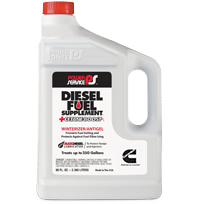
- Step 2 (Continuous Maintenance): Add Power Service Diesel Kleen +Cetane Boost at a 1:500 ratio at every fuel fill-up (at temperatures above +30°F) to prevent deposit reformation, protect fuel pumps with added lubricity, boost cetane up to 6 numbers, and lock in continuous DEF and fuel savings. Below +30°F, add Power Service Diesel Fuel Supplement +Cetane Boost at every fill-up to prevent fuel gelling and protect against fuel filter icing.